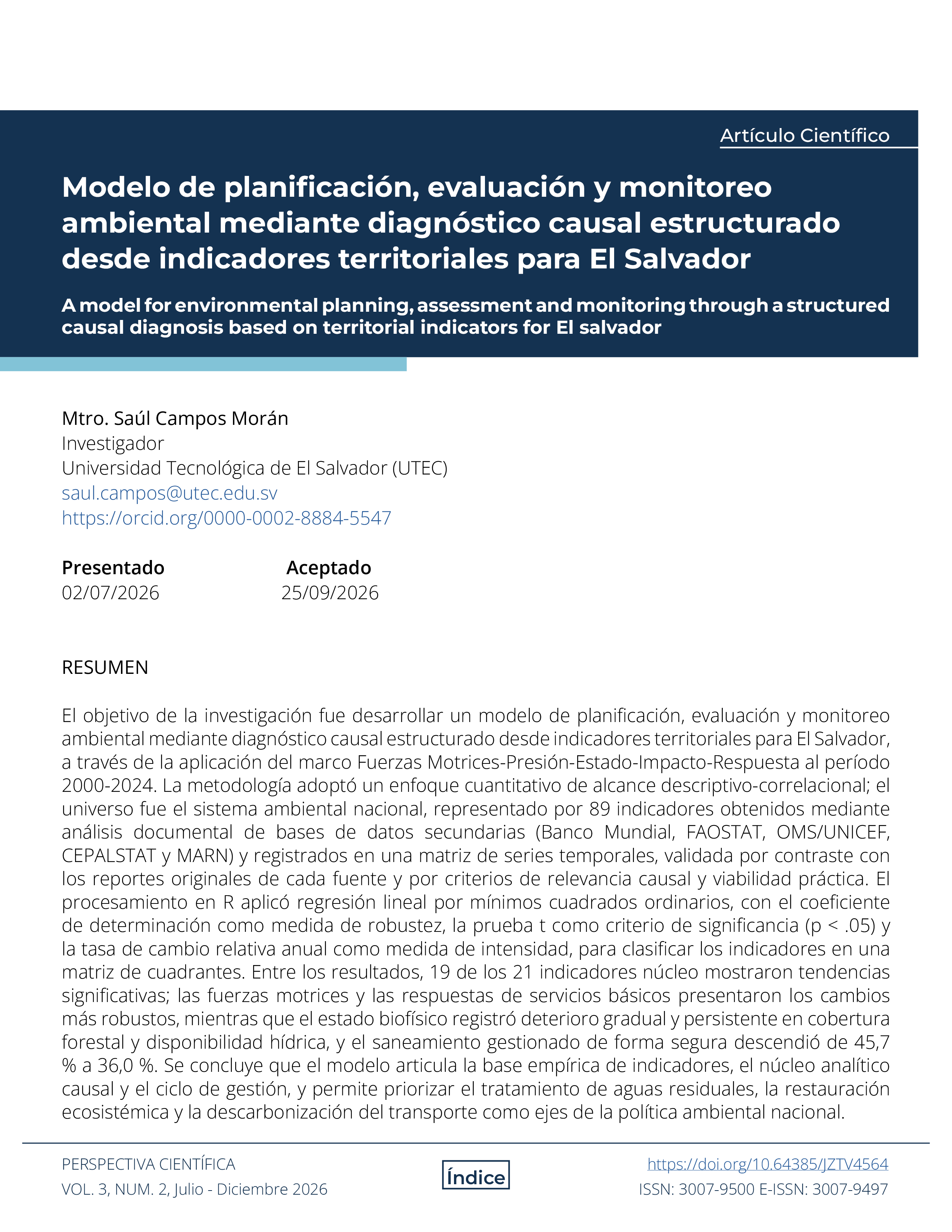
Modelo de planificación, evaluación y monitoreo ambiental mediante diagnóstico causal estructurado desde indicadores territoriales para El Salvador
DOI:
https://doi.org/10.64385/JZTV4564Palabras clave:
indicadores ambientales, planificación ambiental, monitoreo ambiental, evaluación ambiental, degradación del medio ambiente, política ambientalResumen
El objetivo de la investigación fue desarrollar un modelo de planificación, evaluación y monitoreo ambiental mediante diagnóstico causal estructurado desde indicadores territoriales para El Salvador, a través de la aplicación del marco Fuerzas Motrices-Presión-Estado-Impacto-Respuesta al período 2000-2024. La metodología adoptó un enfoque cuantitativo de alcance descriptivo-correlacional; el universo fue el sistema ambiental nacional, representado por 89 indicadores obtenidos mediante análisis documental de bases de datos secundarias (Banco Mundial, FAOSTAT, OMS/UNICEF, CEPALSTAT y MARN) y registrados en una matriz de series temporales, validada por contraste con los reportes originales de cada fuente y por criterios de relevancia causal y viabilidad práctica. El procesamiento en R aplicó regresión lineal por mínimos cuadrados ordinarios, con el coeficiente de determinación como medida de robustez, la prueba t como criterio de significancia (p < .05) y la tasa de cambio relativa anual como medida de intensidad, para clasificar los indicadores en una matriz de cuadrantes. Entre los resultados, 19 de los 21 indicadores núcleo mostraron tendencias significativas; las fuerzas motrices y las respuestas de servicios básicos presentaron los cambios más robustos, mientras que el estado biofísico registró deterioro gradual y persistente en cobertura forestal y disponibilidad hídrica, y el saneamiento gestionado de forma segura descendió de 45,7 % a 36,0 %. Se concluye que el modelo articula la base empírica de indicadores, el núcleo analítico causal y el ciclo de gestión, y permite priorizar el tratamiento de aguas residuales, la restauración ecosistémica y la descarbonización del transporte como ejes de la política ambiental nacional.
Descargas
Referencias
Agencia Europea de Medio Ambiente (AEMA). (1999). Environmental indicators: Typology and overview. European Environment Agency.
https://www.eea.europa.eu/publications/TEC25
Agramont, A., van Cauwenbergh, N., van Griesven, A. y Craps, M. (2022). Integrating spatial and social characteristics in the DPSIR framework for the sustainable management of river basins: Case study of the Katari River Basin, Bolivia. Water International, 47(1), 8-29.
https://doi.org/10.1080/02508060.2021.1997021
Álvarez, L., Vargas, L. y Jiménez, A. (2024). Priorities for the rural water and sanitation services regulation in Latin America. Frontiers in Water, 6, 1406301. https://doi.org/10.3389/frwa.2024.1406301
Anderson, T. G., McKinnon, K. A., Pons, D. y Anchukaitis, K. J. (2023). How exceptional was the 2015- 2019 Central American drought? Geophysical Research Letters, 50(21), e2023GL105391. https://doi.org/10.1029/2023GL105391
Banco Mundial. (2021). El Salvador: Forest Investment Program — Forest governance and finance. World Bank Group.
https://www.worldbank.org/en/country/elsalvador/overview
Banco Mundial. (2025). World Development Indicators [base de datos]. https://databank.worldbank.org/source/world-development-indicators
Benfica, V. y Marques, A. C. (2024). Technological and financial development as drivers of Latin America’s energy transition. Renewable Energy, 237, 121664. https://doi.org/10.1016/j.renene.2024.121664
Carnohan, S. A., Trier, X., Liu, S., Clausen, L. P. W., Clifford-Holmes, J. K., Hansen, S. F., Benini, L. y McKnight, U. S. (2023). Next generation application of DPSIR for sustainable policy implementation. Current Research in Environmental Sustainability, 5, 100201.
https://doi.org/10.1016/j.crsust.2022.100201
Chowdhury, S., Paul, C., Hamidov, A., Bayer, L., Arndt, M., McPherson, J. y Helming, K. (2025) Developing a generic DPSIR framework for land use and soil management: A systems approach to maximise soil health. European Journal of Soil Science, 76(6), e70230.
https://doi.org/10.1111/ejss.70230
Comisión Económica para América Latina y el Caribe (CEPAL). (2023a). La emergencia del cambio climático y el estado del agua en América Latina y el Caribe. CEPAL. https://repositorio.cepal.org/handle/11362/45677
Comisión Económica para América Latina y el Caribe (CEPAL). (2023b). CEPALSTAT: Bases de datos y publicaciones estadísticas [base de datos]. https://statistics.cepal.org/
Committee on Publication Ethics (COPE). (2023). Authorship and AI tools: COPE position statement.
https://publicationethics.org/guidance/cope-position/authorship-and-ai-tools
Depsky, N. y Pons, D. (2021). Meteorological droughts are projected to worsen in Central America’s dry corridor throughout the 21st century. Environmental Research Letters, 16(1), 014001. https://doi.org/10.1088/1748-9326/abc5e2
Faseyi, C. A., Miyittah, M. K. y Yafetto, L. (2023). Assessment of environmental degradation in two coastal communities of Ghana using Driver Pressure State Impact Response (DPSIR) framework. Journal of Environmental Management, 342, 118224.
https://doi.org/10.1016/j.jenvman.2023.118224
Food and Agriculture Organization of the United Nations (FAO). (2020). Global Forest Resources Assessment 2020: Main report. FAO.
https://doi.org/10.4060/ca9825en
Food and Agriculture Organization of the United Nations (FAO). (2023). FAOSTAT [base de datos]. https://www.fao.org/faostat/en/
Gómez-Limón, J. A., Arriaza, M. y Guerrero-Baena, M. D. (2020). Building a composite indicator to measure environmental sustainability using alternative weighting methods. Sustainability, 12(11), 4398. https://doi.org/10.3390/su12114398
Guerra, E., Montejano, J., Reyes, A. y Vergel-Tovar, E. (2023). Transportation and emissions in Latin American cities. Transportation Research Part D: Transport and Environment, 123, 103925. https://doi.org/10.1016/j.trd.2023.103925
Guzmán Sánchez, J., Perevochtchikova, M. y Kolb, M. (2024). Wastewater in Latin American urban peripheries: Identifying research trends and challenges through a systematic literature review. Science of The Total Environment, 931, 173019.
https://doi.org/10.1016/j.scitotenv.2024.173019
Hampl, N. (2022). Equitable energy transition in Latin America and the Caribbean: Reducing inequity by building capacity. Renewable and Sustainable Energy Transition, 2, 100035. https://doi.org/10.1016/j.rset.2022.100035
Hosseini, M., Rasmussen, L. M. y Resnik, D. B. (2023). Using AI to write scholarly publications. Accountability in Research, 30(6), 1-9.
https://doi.org/10.1080/08989621.2023.2168535
Jiménez-Moreno, M. J., Rodríguez-Laguna, R. y Escalona-Maurice, M. J. (2025). Modelo ambiental para el diseño de indicadores ambientales en la subcuenca del río Metztitlán. Áreas Naturales Protegidas Scripta, 11(1), 21-38. https://doi.org/10.18242/anpscripta.2025.11.11.01.0002
Kelemen, A., Szabó, Z. K., Bozóki, S., Szádoczki, Z. y Hartvig, Á. D. (2024). A sensitivity analysis of composite indicators: Min/max thresholds. Environmental and Sustainability Indicators, 23, 100453. https://doi.org/10.1016/j.indic.2024.100453
Kwatra, S., Kumar, A. y Sharma, P. (2020). A critical review of studies related to construction and computation of Sustainable Development Indices. Ecological Indicators, 112, 106061. https://doi.org/10.1016/j.ecolind.2019.106061
Lund, B. D. y Wang, T. (2023). Chatting about ChatGPT: How may AI and GPT impact academia and libraries? Library Hi Tech News, 40(3), 26-29. https://doi.org/10.1108/LHTN-01-2023-0009
Mangones, S. C., Cuéllar-Álvarez, Y., Rojas-Roa, N. Y. y Osses, M. (2025). Addressing urban transport related air pollution in Latin America: Insights and policy directions. Latin American Transport Studies, 3, 100033. https://doi.org/10.1016/j.latran.2025.100033
Ministerio de Medio Ambiente y Recursos Naturales (MARN). (2020). Informe de la calidad del agua de los ríos de El Salvador. MARN.
https://observatoriogeneroyjusticiaambiental.org/informe-de-la-calidad-de-agua-de-los-rios
de-el-salvador-ano-2020/
Ministerio de Medio Ambiente y Recursos Naturales (MARN). (2022). Política Nacional de Medio Ambiente. MARN.
https://cidoc.ambiente.gob.sv/documento/politica-nacional-de-medio-ambiente/
Ministerio de Salud (MINSAL). (2022). Boletín epidemiológico 2022. MINSAL.
Mosaffaie, J., Salehpour Jam, A., Tabatabaei, M. R. y Kousari, M. R. (2021). Trend assessment of the watershed health based on DPSIR framework. Land Use Policy, 100, 104911. https://doi.org/10.1016/j.landusepol.2020.104911
Nakamura, J., Seager, R., Liu, H., Cottier, F., Puma, M. J., Wrathall, D. J., Katz, B., de Sherbinin, A. y Adamo, S. B. (2024). Recent trends in agriculturally relevant climate in Central America. International Journal of Climatology, 44(8), 2701-2724.
https://doi.org/10.1002/joc.8476
Niemeijer, D. y de Groot, R. S. (2008). A conceptual framework for selecting environmental indicator sets. Ecological Indicators, 8(1), 14-25.
https://doi.org/10.1016/j.ecolind.2006.11.012
Organización Mundial de la Salud (OMS) y Fondo de las Naciones Unidas para la Infancia (UNICEF). (2023). Progress on household drinking water, sanitation and hygiene 2000-2022. WHO/UNICEFJMP.
Organización para la Cooperación y el Desarrollo Económicos (OCDE). (1993). OECD core set of indicators for environmental performance reviews. OECD. https://www.oecd.org/env/indicators-modelling-outlooks/
Patel, R. y Argueta Platero, A. A. (2025). Social-ecological implications of land use change on the Balsamo Coast of El Salvador. Regional Environmental Change, 25(3), 85. https://doi.org/10.1007/s10113-025-02397-7
Patrício, J., Elliott, M., Mazik, K., Papadopoulou, K.-N. y Smith, C. J. (2016). DPSIR—Two decades of trying to develop a unifying framework for marine environmental management? Frontiers in Marine Science, 3, 177. https://doi.org/10.3389/fmars.2016.00177
Patrick, E., Girón Palacios, F. y Potts, M. D. (2026). Social-ecological drought and smallholder vulnerability in the Central American Dry Corridor. Ecology and Society, 31(1), 23. https://doi.org/10.5751/ES-16880-31012
Programa de las Naciones Unidas para el Desarrollo (PNUD) y Ministerio de Medio Ambiente y Recursos Naturales (MARN). (2022). El Salvador actualiza sus Contribuciones Nacionalmente Determinadas. PNUD. https://www.undp.org/es/el-salvador/comunicados-de-prensa/el-salvador-presenta-actualizacion-de-su-compromiso-climatico-en-cumplimiento-del-acuerdo-de-paris
Quiroga Martínez, R. (2009). Guía metodológica para desarrollar indicadores ambientales y de desarrollo sostenible en países de América Latina y el Caribe. CEPAL. https://repositorio.cepal.org/handle/11362/5502
Schlosberg, D. (2007). Defining environmental justice: Theories, movements, and nature. Oxford University Press.
https://doi.org/10.1093/acprof:oso/9780199286294.001.0001
Teddlie, C. y Tashakkori, A. (2009). Foundations of mixed methods research: Integrating quantitative and qualitative approaches in the social and behavioral sciences. SAGE Publications.
Unidad de Transacciones (UT). (2024). Estadísticas del mercado eléctrico de El Salvador 2023. UT ElSalvador.
https://www.ut.com.sv/informes-de-mercado
United Nations Environment Programme (UNEP). (2019). Global Environment Outlook 6: Healthy planet, healthy people. Cambridge University Press. https://doi.org/10.1017/9781108627146
Viceministerio de Transporte (VMT). (2023). Estadísticas del parque vehicular registrado en El Salvador 2023. Ministerio de Obras Públicas, Infraestructura, Vivienda y Desarrollo Urbano. https://observatoriovial.fonat.gob.sv/datos-estadisticos/
Yousafzai, S., Saeed, R., Rahman, G. y Farish, S. (2022). Spatio-temporal assessment of land use dynamics and urbanization: Linking with environmental aspects and DPSIR framework approach. Environmental Science and Pollution Research, 29(54), 81337-81350.
https://doi.org/10.1007/s11356-022-21393-6
Zhao, Y., Zhao, X., Fan, D. y Qiu, Y. (2023). A comprehensive method for refining essential SDGs variables for land degradation monitoring based on the DPSIR framework. International Journal of Digital Earth, 16(1), 741-761.
Publicado
Número
Sección
Categorías
Licencia
Derechos de autor 2026 Saúl Campos Morán (Autor/a)

Esta obra está bajo una licencia internacional Creative Commons Atribución-NoComercial-CompartirIgual 4.0.