RETHINKING THE BIRTH OF SCIENTIFIC PSYCHOLOGY: PSYCHOPHYSICS BETWEEN PHILOSOPHICAL PSYCHOLOGY AND PHYSIOLOGICAL PSYCHOLOGY
LA PSICOFÍSICA ENTRE LA PSICOLOGÍA FILOSÓFICA Y LA PSICOLOGÍA FISIOLÓGICA
DOI:
https://doi.org/10.64385/UZFZ4531Keywords:
Rethinking, Wundt, philosophical psychology, psychophysics, physiological psychologyAbstract
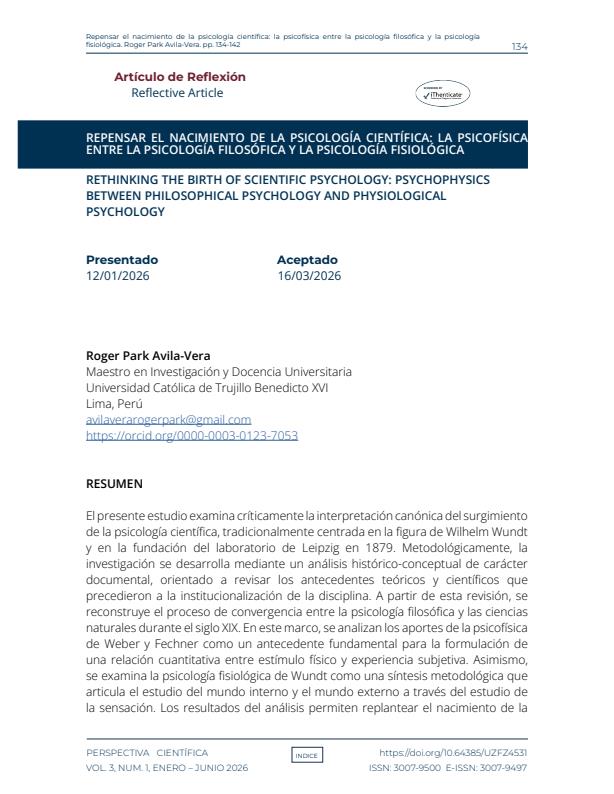
This study critically examines the canonical interpretation of the emergence of scientific psychology, traditionally centered on the figure of Wilhelm Wundt and the founding of the Leipzig laboratory in 1879. Methodologically, the research is conducted through a historical-conceptual documentary analysis, aimed at reviewing the theoretical and scientific antecedents that preceded the institutionalization of the discipline. Based on this review, the study reconstructs the process of convergence between philosophical psychology and natural sciences during the nineteenth century. Within this framework, the contributions of the psychophysics of Weber and Fechner are analyzed as a fundamental antecedent for the formulation of a quantitative relationship between physical stimulus and subjective experience. Likewise, Wundt’s physiological psychology is examined as a methodological synthesis that articulates the study of the internal and external worlds through the study of sensation. The results of the analysis make it possible to reconsider the birth of scientific psychology not as an abrupt rupture, but rather as the result of a gradual process of convergence between philosophical and scientific traditions.
Downloads
References
Ardila, R. (2010). La unidad de la psicología. El paradigma de la síntesis experimental del comportamiento. Revista Mexicana de investigación en psicología, 2(2), 72- 83. https://www.medigraphic.com/pdfs/revmexinvpsi/mip-2010/mip102b.pdf DOI: https://doi.org/10.32870/rmip.vi.477
Bunge, M. y Ardila, R. (1988). Filosofía de la psicología. Siglo XXI. https://archive.org/details/bunge-mario-y-ardila-ruben-filosofia-de-la- psicologia-pr_159075d99f/page/n1/mode/2up
Caparrós, A. (1980). Historia de la Psicología. Ediciones CEAC. https://uniclanet.unicla.edu.mx/assets/contenidos/341620231006094959.pdf
Caparrós, A. (1991). Crisis de la Psicología: ¿singular o plural? Aproximación a algo más que un concepto historiográfico. Anuario de Psicología, 51, 5-20. https://dialnet.unirioja.es/servlet/articulo?codigo=2945296
Dussel, E. (2010). El siglo XXI: nueva edad en la historia de la filosofía en tanto diálogo mundial entre tradiciones filosóficas. Signos filosóficos, XII (23), 119-140. https://www.scielo.org.mx/pdf/signosf/v12n23/v12n23a5.pdf
Estany, A. (1999). Vida, muerte y resurrección de la conciencia. Análisis filosófico de las revoluciones científicas en la psicología contemporánea. Paidós.
Ferreira, A. A. L. (2003). O lugar da psicofísica de Gustav Fechner na história da psicologia. Memorandum, 5, 86-93. https://www.academia.edu/125238386/O_lugar_da_psicof%C3%ADsica_de_ Gustav_Fechner_na_hist%C3%B3ria_da_psicologia
Fontes, S. y Fontes A. I. (1994). Consideraciones teóricas sobre las leyes psicofísicas. Revista de Psicología General y Aplicada, 47(4), 391-395. https://dialnet.unirioja.es/servlet/articulo?codigo=2385276
Vánzago, L. (2011). Breve historia del alma. FCE. https://archive.org/details/BreveHistoriaDelAlmaLucaVanzago
Yela, M. (1996). Unidad y diversidad en psicología. Psicothema, 8, 327-351. https://www.psicothema.com/pi?pii=664
Wundt, W. (1874). “Introduction”. En: Elements de Psychologie Physiologique. Paris: Felix Alcan Editeur. (Traducción: Lic. Rosa Falcone y Lic. Roberto Bortnik).
Downloads
Published
Issue
Section
License

This work is licensed under a Creative Commons Attribution-NonCommercial-ShareAlike 4.0 International License.