Perceptions of teaching staff-researchers from the Evangelical University of El Salvador regarding qualitative research in health, from 2020 to 2024
DOI:
https://doi.org/10.64385/BQXH8139Keywords:
qualitative methodology, perceptions, teaching staff, researchers, El SalvadorAbstract
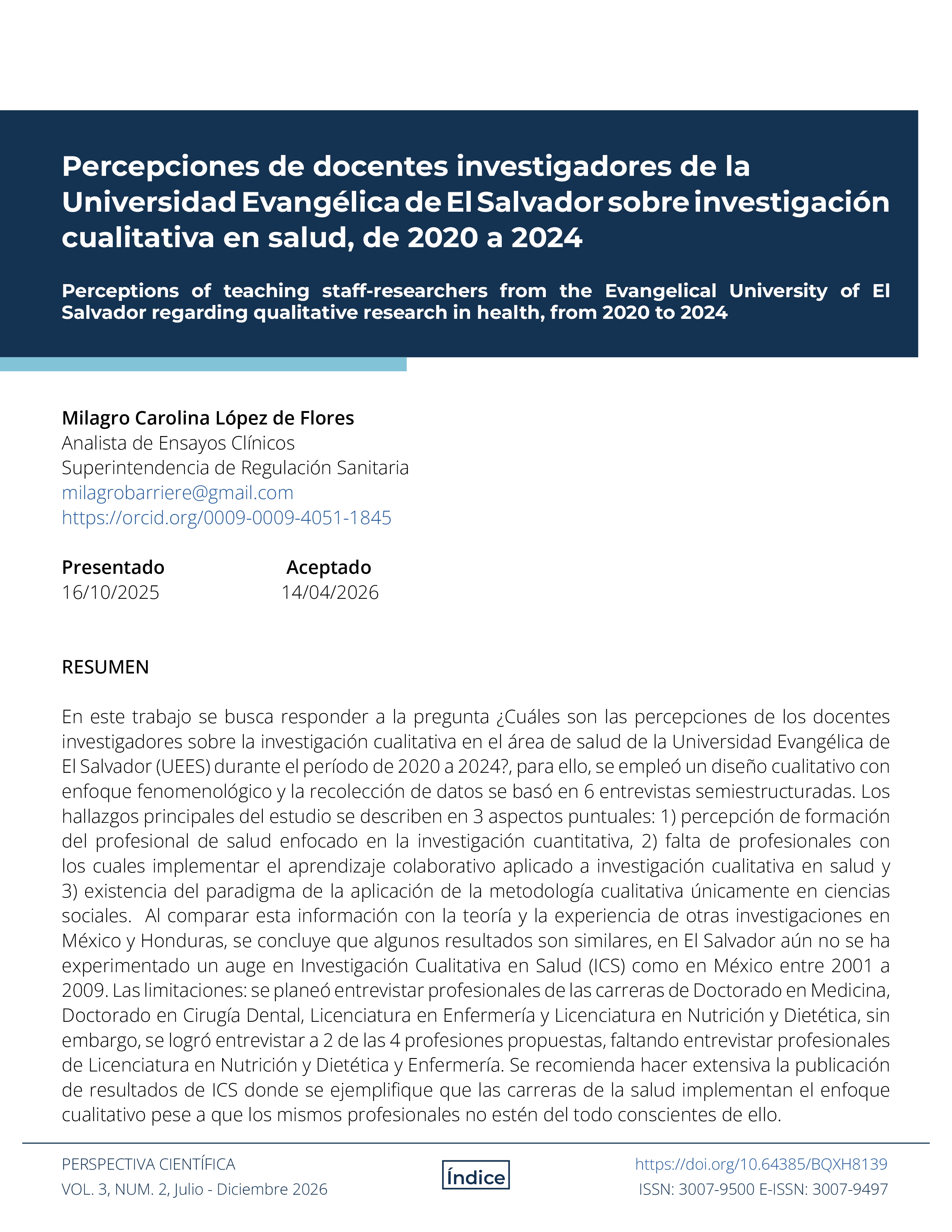
This study seeks to answer the question: What are the perceptions of research-oriented faculty
regarding qualitative research in the health area at the Universidad Evangélica de El Salvador (UEES)
during the period from 2020 to 2024? To address this, a qualitative design with a phenomenological
approach was employed, and data collection was based on six semi-structured interviews. The
study’s main findings are described in three specific aspects: 1) perception of health professional
training being focused on quantitative research; 2) a lack of professionals with whom to implement
collaborative learning applied to qualitative health research; and 3) the existence of a paradigm that
qualitative methodology is only applicable in social sciences. By comparing this information with
theory and the experience of other research in Mexico and Honduras, it is concluded that some
results are similar. However, El Salvador has yet to experience a boom in Qualitative Health Research
(QHR), unlike Mexico between 2001 and 2009. Regarding the research limitations: only two of the
four proposed professions were successfully interviewed (Doctorate in Medicine and Dental Surgery
professionals), as professionals from the Nutrition and Dietetics and Nursing programs who met the
selection criteria were unavailable. It is recommended to broaden the publication of QHR results
that exemplify how health careers implement a qualitative approach, even though the professionals
themselves may not be entirely conscious of it
Downloads
References
Bacigalupe, M. de los Á., & Strasser, G. (2022). Desafiando el estigma de vivir con enfermedad de Parkinson desde un grupo de soporte. Investiga+, 5(5), pág. 41–56. https://revistas.upc.edu.ar/investiga-mas/article/view/102/214
Barrio-Cantalejo I.M., Simón-Lorda P. (2006) Problemas éticos de la investigación cualitativa. Med Clin.,126:418-23 https://www.elsevier.es/es-revista-medicina-clinica-2-articulo-problemas-eticosinvestigacion-cualitativa-13086126?newsletter=true
Bedregal, Paula, Besoain, Carolina, Reinoso, Alejandro, & Zubarew, Tamara. (2017). La investigación cualitativa: un aporte para mejorar los servicios de salud. Revista médica de Chile, 145(3), 373-379. https://dx.doi.org/10.4067/S0034-98872017000300012
Carreño, J. M., Sánchez-Argüello, M. & Sánchez-Montoya, C. E. (2007). La investigación Docente en Perspectiva Crítica. Horiz. Pedagóg. Volumen 9, N° 1, Año 2007, p. 19-26 https://dialnet.unirioja.es/servlet/articulo?codigo=4907027
Creswell, J. W. (2007). Qualitative inquiry and research design: Choosing among five approaches (3rd ed.) p.107-114.
Conejero, J. (2020) Una Aproximación a la Investigación Cualitativa. Neumol Pediatr 2020; 15 (1): 242 – 244 https://www.researchgate.net/publication/348782331_UNA_APROXIMACION_A_LA_INVESTIGACION_CUALITATIVA
Duque-Cardona, S. (1999) Dimensión del cuidado de enfermería a los colectivos; un espacio para la promoción de la salud y la producción de conocimiento. Investigación y Educación en Enfermería,17(1) p.75-85 https://revistas.udea.edu.co/index.php/iee/article/view/16890/14622
Goffman, E. (2003) Estigma. La identidad deteriorada. Buenos Aires, Amorrortu
Gómez Escoto, R. A. (2022). Producción científica de las universidades de El Salvador, en la década del 2008 al 2018. Revista Minerva, 5(4), 47–60. https://doi.org/10.5377/revminerva.v5i4.15788
Google. (2025). Gemini (modelo de lenguaje grande) https://gemini.google.com
Gürsoy, E., Vatansever, M. (2025) Percepciones, desafíos y oportunidades de la investigación cualitativa entre académicos médicos inexpertos. BMC Med Educ 25, 1220 (2025). https://doi.org/10.1186/s12909-025-07824-1
Landaverde Martínez, A. (2016). La importancia de las narrativas en el encuentro clínico: hacia una comprensión dialógica del padecer. Revista CONAMED, 21(Extra 2), 90–93. https://dialnet.unirioja.es/servlet/articulo?codigo=7302023
Mendoza R. (2006) Investigación cualitativa y cuantitativa. Diferencias y limitaciones. https://www.insp.mx/images/stories/Centros/nucleo/docs/dip_lsp/cualitativa.pdf
Mercado, F. J., Bosi, M. L., Robles Silva, L., Wiessenfeld, E., y Pla, M. (2005). La enseñanza de la investigación cualitativa en Salud: voces desde Iberoamérica. Salud Colectiva, 1(1), 97–116. https://dialnet.unirioja.es/servlet/articulo?codigo=2511275
Mercado-Martínez FJ, Díaz BA, Tejada-Tabayas LM, Ascencio-Mera CD. Investigación cualitativa en salud. Una revisión crítica de la producción bibliográfica en México. (2011) Salud Publica Mex, 53, 504- 512. https://www.scielosp.org/pdf/spm/v53n6/a06v53n6.pdf
Ministerio de Educación, Ciencia y Tecnología (2021), Política Nacional de Educación Superior de El Salvador. https://secretariageneral.unasa.edu.sv/legislacionnacional/Politica%20Nacional%20de%20Educacion%20Superior.pdf
Patton, M. (1990). Qualitative evaluation and research methods (pp. 169-186). Beverly Hills, CA: Sage
Pole, K. (2008) Diseño de metodologías mixtas: Una revisión de las estrategias para combinar metodologías cuantitativas y cualitativas. Renglones, 60, 35-42 https://rei.iteso.mx/server/api/core/bitstreams/ee397b99-bb24-4c3e-ba94-b9dde4563026/content
Fajardo Ramos, E., Núñez Rodríguez, M.L., & Henao Castaño, A.M. (2022). Percepción de docentes de Enfermería entorno a la investigación formativa. Cultura de los Cuidados (Edición digital), 26(63). http://dx.doi.org/10.14198/cuid.2022.63.10
Raudales García, N. R. (2021). Percepción sobre investigación científica entre estudiantes de ciencias de la salud de UNITEC. Innovare. Revista de ciencia y tecnología, 10(2), 58–63. https://revistas.unitec.edu/innovare/article/view/148
Rodríguez-Gómez R. (2023) Investigaciones cualitativas en salud pública publicadas en revistas biomédicas colombianas entre el 2011 y el 2021. Biomédica, 43 (1), 69-82. https://doi.org/10.7705/biomedica.6476
Sánchez, A. (2001). El método hermenéutico aplicado a un nuevo Canon: hacia la autorización de la producción escrita de los estudiantes de inglés. CAUCE, Revista de Filología y su Didáctica, 24, 295-323. https://cvc.cervantes.es/literatura/cauce/pdf/cauce24/cauce24_18.pdf
Sanguino, N. (2021), Fenomenología como método de investigación cualitativa: preguntas desde la práctica investigativa. Revista Latinoamericana de Metodología de la Investigación Social, 10 (20), 7-18 http://relmis.com.ar/ojs/index.php/relmis/article/view/fenomenologia_como_metodo/167
Tashakkori, A., y Teddlie, C. (2003). Handbook of mixed methods in social and behavioral research. Sage, Thousand Oaks, California https://books.google.com.sv/books?id=F8BFOM8DCKoC&pg=PR3&hl=es&source=gbs_selected_pages&cad=1#v=onepage&q&f=false
Universidad Pedagógica de El Salvador (2025). Diplomado en Investigación Cualitativa. https://www.pedagogica.edu.sv/facultad-de-posgrados-y-educacion-continua/diplomado-en-investigacion-cualitativa/
Universidad Evangélica de El Salvador (2025 a). Diseño de Instrumentos de Recolección de Datos Cualitativos. https://posgrados.uees.edu.sv/curso-de-diseno-de-instrumentos-de-recoleccion-de-datos-cualitativos/
Downloads
Published
Issue
Section
Categories
License
Copyright (c) 2026 Milagro Carolina López de Flores (Autor/a)

This work is licensed under a Creative Commons Attribution-NonCommercial-ShareAlike 4.0 International License.