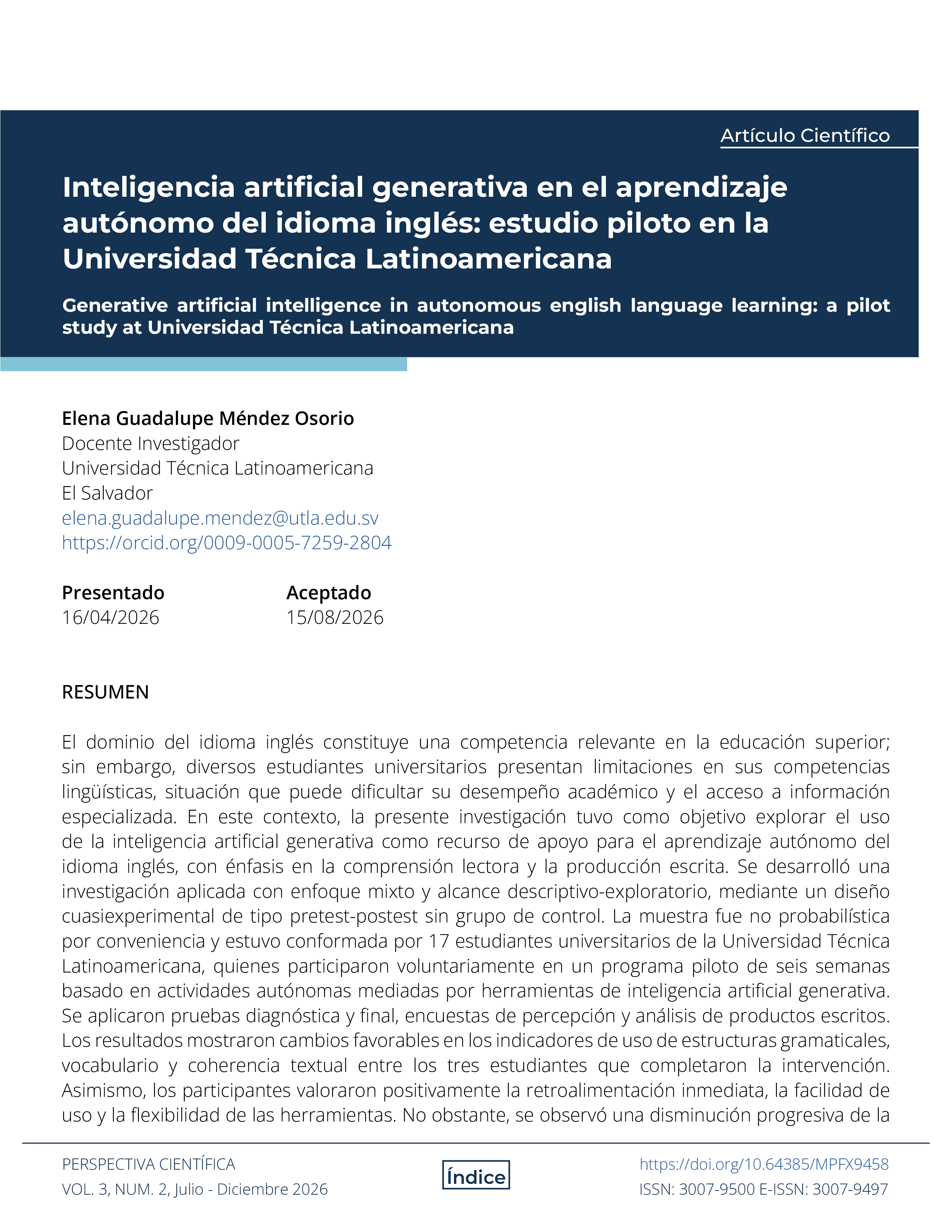
Generative artificial intelligence in autonomous english language learning: a pilot study at Universidad Técnica Latinoamericana
DOI:
https://doi.org/10.64385/MPFX9458Keywords:
artificial intelligence, autonomous learning, English language, higher education, skills development, teaching-learning processAbstract
English language proficiency constitutes a relevant competence in higher education; however, many university students experience limitations in their language skills, which may affect their academic performance and access to specialized information. In this context, the present study aimed to explore the use of generative artificial intelligence as a support resource for autonomous English language learning, with emphasis on reading comprehension and written production. An applied mixed-methods study with a descriptive-exploratory scope was conducted using a quasi-experimental pretest-posttest design without a control group. The sample was non-probabilistic and convenience-based, comprising 17 university students from Universidad Técnica Latinoamericana who voluntarily participated in a six-week pilot program based on autonomous activities mediated by generative artificial intelligence tools. A diagnostic test, a final test, perception surveys, and an analysis of written products were administered. The results showed favorable changes in the indicators related to the use of grammatical structures, vocabulary, and textual coherence among the three students who completed the intervention. Participants also reported positive perceptions of the tools, particularly regarding immediate feedback, ease of use, and flexibility. However, participation progressively declined, reaching three students at the end of the program, equivalent to 17.65% of the initial sample. Difficulties related to time management, consistency, and follow-up complemented the description of this pattern. It is concluded that generative artificial intelligence constitutes a support resource with potential for language practice, whose integration requires pedagogical strategies that articulate learner autonomy, digital competencies, guidance, and follow-up. The findings are limited to the specific conditions of the study and cannot be generalized to other populations.
Downloads
References
Benson, P. (2011). What’s new in autonomy. The Language Teacher, 35(4), 15-18. https://jalt-publications.org/sites/default/files/pdf-article/plen3.pdf
Campi, W. (2023). Educación Híbrida e Inteligencia Artificial Generativa: una revisión crítica. Minerva, 2(7). https://editorialiupfa.com/ojs/index.php/minerva/article/view/162
Crystal, D. (2003). English as a global language. Cambridge University Press.
https://www.cambridge.org/core/books/english-as-a-global-language/690D300092A3B5E4733677FCC9A42E98
González-Fernández-Villavicencio, N. (2015). DigComp o la necesaria adecuación al marco común de referencia en competencias digitales. Anuario ThinkEPI, 9, 030-035. http://dx.doi.org/10.3145/thinkepi.2015.04
Granizo, D. W. C. (2025). Impacto de la inteligencia artificial generativa en la mejora del rendimiento académico y la retroalimentación personalizada en estudiantes universitarios. Remulci, 3. https://doi.org/10.59282/remulci.3.1.1171
Gutiérrez, G. F. G., Guerrero, J. A. T., Peralta, C. E. M., & Cevallos, R. C. E. (2025). Uso de inteligencia artificial generativa como herramienta de apoyo académico en la innovación pedagógica universitaria. Revista Social Fronteriza, 5(6). https://doi.org/10.59814/resofro.2025.5(6)955
Hyland, K. (2016). Methods and methodologies in second language writing research. System, 59, 116-125. https://doi.org/10.1016/j.system.2016.05.002
Kasneci, E., Seßler, K., Küchemann, S., Bannert, M., Dementieva, D., Fischer, F., & Kasneci, G. (2023). ChatGPT for good? On opportunities and challenges of large language models for education. Learning and individual differences, 103, 102274.
https://epub.ub.uni-muenchen.de/125071/1/ChatGPT_for_Good_v3.pdf
Leiva-Guerrero, M. V., Zamorano, I. A., Collins, R. E., & Castro, F. S. (2026) Retroalimentación de aprendizajes con inteligencia artificial generativa en estudiantes universitarios. RIED-Revista Iberoamericana de Educación a Distancia, 29(1), 241-267. https://doi.org/10.5944/ried.45547
Little, D. (2003). Learner autonomy and second/foreign language learning. Guide to good practice, 1-23.
https://web-archive.southampton.ac.uk/www.llas.ac.uk/resources/gpg/1409.html
Ramírez-Romero, J. L., Erizeira Ruiz-Chávez, A. y Peña-Medina, S. (2021). Relación entre desempeño laboral y especialidades: El caso de los egresados de una licenciatura en enseñanza del inglés. Archivos Analíticos de Políticas Educativas, 29(103). https://doi.org/10.14507/epaa.29.5880
Redecker, C. (2017). European framework for the digital competence of educators: DigCompEdu.
https://publications.jrc.ec.europa.eu/repository/handle/JRC107466
Ricalday, M. E. (2023). Las herramientas digitales como agentes promotores del aprendizaje autónomo en inglés. Huellas Literarias Normalistas-Vol. 4, 20. https://www.researchgate.net/profile/Laura-Acosta-Perez-2/publication/370492210_HUELLAS_LITERARIAS_NORMALISTAS-Vol_4_El_trabajo_de_pensar_un_enfoque_reflexivo/links/6452bf7c97449a0e1a760dc9/HUELLAS-LITERARIAS-NORMALISTAS-Vol-4-El-trabajo-de-pensar-un-enfoque-reflexivo.pdf#page=20
Romani Pillpe, G., Macedo Inca, K. S., Soto Loza, G. E., Franco Guevara, A. M., & Ore Choque, M. K. (2025). Revisión sistemática de inteligencia artificial generativa (GenIA) para el diseño de experiencias de aprendizaje, 2020-2025. Revista Espacios, 46(3), 13-27. https://doi.org/10.48082/espacios-a25v46n03p02
Santillán-Aguirre, P., Santos-Poveda, R., Cuadrado-Solis, V., & Hernández-Andrade, L. (2025). Integración de inteligencia artificial generativa en metodologías activas para la enseñanza. Universidad y Sociedad, 17(5), e5224. https://rus.ucf.edu.cu/index.php/rus/article/view/5224
Serrano, J. L., & Moreno-García, J. (2024). Inteligencia artificial y personalización del aprendizaje: ¿innovación educativa o promesas recicladas? Edutec, Revista Electrónica de Tecnología Educativa, (89), 1-17. https://doi.org/10.21556/edutec.2024.89.3577
Thoms, K. J. (2001). They're Not Just Big Kids: Motivating Adult Learners. https://files.eric.ed.gov/fulltext/ED463720.pdf
Tinto, V. (2012). Enhancing student success: Taking the classroom success seriously. The International Journal of the First Year in Higher Education, 3(1). 1–8. https://pdfs.semanticscholar.org/340c/17a437b6af55a7d18fa2bd178c2b5171da71.pdf
Urbáez, Y. L. P., Troncoso, D., García, P. P. F., & Merant, N. (2025). La inteligencia artificial en la enseñanza/aprendizaje del idioma inglés. Una revisión sistemática. AULA Revista de Humanidades y Ciencias Sociales, 71(2), 10. https://dialnet.unirioja.es/servlet/articulo?codigo=10370986
Villón, M. P. C. (2024). Estrategias para integrar herramientas de inteligencia artificial generativa en el proceso de enseñanza-aprendizaje universitario. Revista internacional de Investigación y Desarrollo Global, 3(4), 1-16. https://doi.org/10.64041/riidg.v3i4.27
Zawacki-Richter, O., Marín, V. I., Bond, M., & Gouverneur, F. (2019). Systematic review of research on artificial intelligence applications in higher education–where are the educators? International journal of educational technology in higher education, 16(1), 39. https://doi.org/10.1186/s41239-019-0171-0
Zimmerman, B. J. (2002). Becoming a self-regulated learner: An overview. Theory into practice, 41(2), 64-70. http://mathedseminar.pbworks.com/w/file/fetch/94760840/Zimmerman%20-%202002%20-%20Becoming%20a%20SelfRegulated%20Learner%20An%20Overview.pdf
Downloads
Published
Issue
Section
Categories
License
Copyright (c) 2026 Elena Guadalupe Méndez Osorio (Autor/a)

This work is licensed under a Creative Commons Attribution-NonCommercial-ShareAlike 4.0 International License.