A model for environmental planning, assessment and monitoring through a structured causal diagnosis based on territorial indicators for El salvador
DOI:
https://doi.org/10.64385/JZTV4564Keywords:
environmental indicators, environmental planning, environmental monitoring, environmental assessment, environmental degradation, environmental policyAbstract
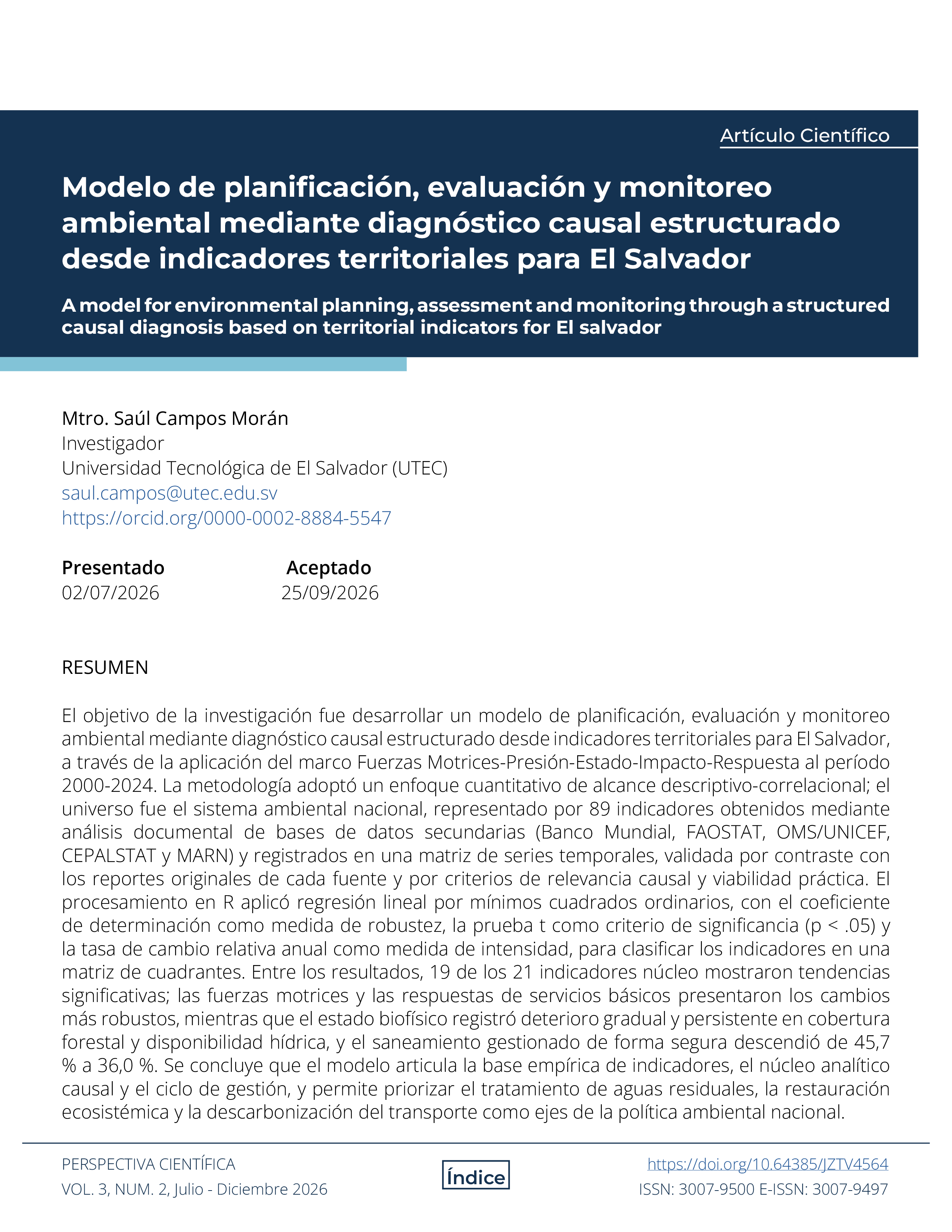
The objective of this study was to develop a model for environmental planning, assessment and monitoring through a structured causal diagnosis based on territorial indicators for El Salvador, by applying the Driving Forces-Pressure-State-Impact-Response framework to the period 2000-2024. The methodology adopted a quantitative approach with a descriptive-correlational scope; the universe was the national environmental system, represented by 89 indicators obtained through documentary analysis of secondary databases (World Bank, FAOSTAT, WHO/UNICEF, CEPALSTAT and MARN) and recorded in a time-series matrix, validated by cross-checking against the original reports of each source and by criteria of causal relevance and practical feasibility. Data were processed in R through ordinary least squares linear regression, using the coefficient of determination as a measure of robustness, the t test as the significance criterion (p < .05) and the annual relative rate of change as a measure of intensity, which allowed the indicators to be classified in a quadrant matrix. Among the results, 19 of the 21 core indicators showed significant trends; driving forces and basic-service responses displayed the most robust changes, whereas the biophysical state showed gradual and persistent deterioration in forest cover and water availability, and safely managed sanitation declined from 45.7 % to 36.0 %. The study concludes that the model links the empirical indicator base, the causal analytical core and the management cycle, and makes it possible to prioritize wastewater treatment, ecosystem restoration and transport decarbonization as the main axes of national environmental policy.
Downloads
References
Agencia Europea de Medio Ambiente (AEMA). (1999). Environmental indicators: Typology and overview. European Environment Agency.
https://www.eea.europa.eu/publications/TEC25
Agramont, A., van Cauwenbergh, N., van Griesven, A. y Craps, M. (2022). Integrating spatial and social characteristics in the DPSIR framework for the sustainable management of river basins: Case study of the Katari River Basin, Bolivia. Water International, 47(1), 8-29.
https://doi.org/10.1080/02508060.2021.1997021
Álvarez, L., Vargas, L. y Jiménez, A. (2024). Priorities for the rural water and sanitation services regulation in Latin America. Frontiers in Water, 6, 1406301. https://doi.org/10.3389/frwa.2024.1406301
Anderson, T. G., McKinnon, K. A., Pons, D. y Anchukaitis, K. J. (2023). How exceptional was the 2015- 2019 Central American drought? Geophysical Research Letters, 50(21), e2023GL105391. https://doi.org/10.1029/2023GL105391
Banco Mundial. (2021). El Salvador: Forest Investment Program — Forest governance and finance. World Bank Group.
https://www.worldbank.org/en/country/elsalvador/overview
Banco Mundial. (2025). World Development Indicators [base de datos]. https://databank.worldbank.org/source/world-development-indicators
Benfica, V. y Marques, A. C. (2024). Technological and financial development as drivers of Latin America’s energy transition. Renewable Energy, 237, 121664. https://doi.org/10.1016/j.renene.2024.121664
Carnohan, S. A., Trier, X., Liu, S., Clausen, L. P. W., Clifford-Holmes, J. K., Hansen, S. F., Benini, L. y McKnight, U. S. (2023). Next generation application of DPSIR for sustainable policy implementation. Current Research in Environmental Sustainability, 5, 100201.
https://doi.org/10.1016/j.crsust.2022.100201
Chowdhury, S., Paul, C., Hamidov, A., Bayer, L., Arndt, M., McPherson, J. y Helming, K. (2025) Developing a generic DPSIR framework for land use and soil management: A systems approach to maximise soil health. European Journal of Soil Science, 76(6), e70230.
https://doi.org/10.1111/ejss.70230
Comisión Económica para América Latina y el Caribe (CEPAL). (2023a). La emergencia del cambio climático y el estado del agua en América Latina y el Caribe. CEPAL. https://repositorio.cepal.org/handle/11362/45677
Comisión Económica para América Latina y el Caribe (CEPAL). (2023b). CEPALSTAT: Bases de datos y publicaciones estadísticas [base de datos]. https://statistics.cepal.org/
Committee on Publication Ethics (COPE). (2023). Authorship and AI tools: COPE position statement.
https://publicationethics.org/guidance/cope-position/authorship-and-ai-tools
Depsky, N. y Pons, D. (2021). Meteorological droughts are projected to worsen in Central America’s dry corridor throughout the 21st century. Environmental Research Letters, 16(1), 014001. https://doi.org/10.1088/1748-9326/abc5e2
Faseyi, C. A., Miyittah, M. K. y Yafetto, L. (2023). Assessment of environmental degradation in two coastal communities of Ghana using Driver Pressure State Impact Response (DPSIR) framework. Journal of Environmental Management, 342, 118224.
https://doi.org/10.1016/j.jenvman.2023.118224
Food and Agriculture Organization of the United Nations (FAO). (2020). Global Forest Resources Assessment 2020: Main report. FAO.
https://doi.org/10.4060/ca9825en
Food and Agriculture Organization of the United Nations (FAO). (2023). FAOSTAT [base de datos]. https://www.fao.org/faostat/en/
Gómez-Limón, J. A., Arriaza, M. y Guerrero-Baena, M. D. (2020). Building a composite indicator to measure environmental sustainability using alternative weighting methods. Sustainability, 12(11), 4398. https://doi.org/10.3390/su12114398
Guerra, E., Montejano, J., Reyes, A. y Vergel-Tovar, E. (2023). Transportation and emissions in Latin American cities. Transportation Research Part D: Transport and Environment, 123, 103925. https://doi.org/10.1016/j.trd.2023.103925
Guzmán Sánchez, J., Perevochtchikova, M. y Kolb, M. (2024). Wastewater in Latin American urban peripheries: Identifying research trends and challenges through a systematic literature review. Science of The Total Environment, 931, 173019.
https://doi.org/10.1016/j.scitotenv.2024.173019
Hampl, N. (2022). Equitable energy transition in Latin America and the Caribbean: Reducing inequity by building capacity. Renewable and Sustainable Energy Transition, 2, 100035. https://doi.org/10.1016/j.rset.2022.100035
Hosseini, M., Rasmussen, L. M. y Resnik, D. B. (2023). Using AI to write scholarly publications. Accountability in Research, 30(6), 1-9.
https://doi.org/10.1080/08989621.2023.2168535
Jiménez-Moreno, M. J., Rodríguez-Laguna, R. y Escalona-Maurice, M. J. (2025). Modelo ambiental para el diseño de indicadores ambientales en la subcuenca del río Metztitlán. Áreas Naturales Protegidas Scripta, 11(1), 21-38. https://doi.org/10.18242/anpscripta.2025.11.11.01.0002
Kelemen, A., Szabó, Z. K., Bozóki, S., Szádoczki, Z. y Hartvig, Á. D. (2024). A sensitivity analysis of composite indicators: Min/max thresholds. Environmental and Sustainability Indicators, 23, 100453. https://doi.org/10.1016/j.indic.2024.100453
Kwatra, S., Kumar, A. y Sharma, P. (2020). A critical review of studies related to construction and computation of Sustainable Development Indices. Ecological Indicators, 112, 106061. https://doi.org/10.1016/j.ecolind.2019.106061
Lund, B. D. y Wang, T. (2023). Chatting about ChatGPT: How may AI and GPT impact academia and libraries? Library Hi Tech News, 40(3), 26-29. https://doi.org/10.1108/LHTN-01-2023-0009
Mangones, S. C., Cuéllar-Álvarez, Y., Rojas-Roa, N. Y. y Osses, M. (2025). Addressing urban transport related air pollution in Latin America: Insights and policy directions. Latin American Transport Studies, 3, 100033. https://doi.org/10.1016/j.latran.2025.100033
Ministerio de Medio Ambiente y Recursos Naturales (MARN). (2020). Informe de la calidad del agua de los ríos de El Salvador. MARN.
https://observatoriogeneroyjusticiaambiental.org/informe-de-la-calidad-de-agua-de-los-rios
de-el-salvador-ano-2020/
Ministerio de Medio Ambiente y Recursos Naturales (MARN). (2022). Política Nacional de Medio Ambiente. MARN.
https://cidoc.ambiente.gob.sv/documento/politica-nacional-de-medio-ambiente/
Ministerio de Salud (MINSAL). (2022). Boletín epidemiológico 2022. MINSAL.
Mosaffaie, J., Salehpour Jam, A., Tabatabaei, M. R. y Kousari, M. R. (2021). Trend assessment of the watershed health based on DPSIR framework. Land Use Policy, 100, 104911. https://doi.org/10.1016/j.landusepol.2020.104911
Nakamura, J., Seager, R., Liu, H., Cottier, F., Puma, M. J., Wrathall, D. J., Katz, B., de Sherbinin, A. y Adamo, S. B. (2024). Recent trends in agriculturally relevant climate in Central America. International Journal of Climatology, 44(8), 2701-2724.
https://doi.org/10.1002/joc.8476
Niemeijer, D. y de Groot, R. S. (2008). A conceptual framework for selecting environmental indicator sets. Ecological Indicators, 8(1), 14-25.
https://doi.org/10.1016/j.ecolind.2006.11.012
Organización Mundial de la Salud (OMS) y Fondo de las Naciones Unidas para la Infancia (UNICEF). (2023). Progress on household drinking water, sanitation and hygiene 2000-2022. WHO/UNICEFJMP.
Organización para la Cooperación y el Desarrollo Económicos (OCDE). (1993). OECD core set of indicators for environmental performance reviews. OECD. https://www.oecd.org/env/indicators-modelling-outlooks/
Patel, R. y Argueta Platero, A. A. (2025). Social-ecological implications of land use change on the Balsamo Coast of El Salvador. Regional Environmental Change, 25(3), 85. https://doi.org/10.1007/s10113-025-02397-7
Patrício, J., Elliott, M., Mazik, K., Papadopoulou, K.-N. y Smith, C. J. (2016). DPSIR—Two decades of trying to develop a unifying framework for marine environmental management? Frontiers in Marine Science, 3, 177. https://doi.org/10.3389/fmars.2016.00177
Patrick, E., Girón Palacios, F. y Potts, M. D. (2026). Social-ecological drought and smallholder vulnerability in the Central American Dry Corridor. Ecology and Society, 31(1), 23. https://doi.org/10.5751/ES-16880-31012
Programa de las Naciones Unidas para el Desarrollo (PNUD) y Ministerio de Medio Ambiente y Recursos Naturales (MARN). (2022). El Salvador actualiza sus Contribuciones Nacionalmente Determinadas. PNUD. https://www.undp.org/es/el-salvador/comunicados-de-prensa/el-salvador-presenta-actualizacion-de-su-compromiso-climatico-en-cumplimiento-del-acuerdo-de-paris
Quiroga Martínez, R. (2009). Guía metodológica para desarrollar indicadores ambientales y de desarrollo sostenible en países de América Latina y el Caribe. CEPAL. https://repositorio.cepal.org/handle/11362/5502
Schlosberg, D. (2007). Defining environmental justice: Theories, movements, and nature. Oxford University Press.
https://doi.org/10.1093/acprof:oso/9780199286294.001.0001
Teddlie, C. y Tashakkori, A. (2009). Foundations of mixed methods research: Integrating quantitative and qualitative approaches in the social and behavioral sciences. SAGE Publications.
Unidad de Transacciones (UT). (2024). Estadísticas del mercado eléctrico de El Salvador 2023. UT ElSalvador.
https://www.ut.com.sv/informes-de-mercado
United Nations Environment Programme (UNEP). (2019). Global Environment Outlook 6: Healthy planet, healthy people. Cambridge University Press. https://doi.org/10.1017/9781108627146
Viceministerio de Transporte (VMT). (2023). Estadísticas del parque vehicular registrado en El Salvador 2023. Ministerio de Obras Públicas, Infraestructura, Vivienda y Desarrollo Urbano. https://observatoriovial.fonat.gob.sv/datos-estadisticos/
Yousafzai, S., Saeed, R., Rahman, G. y Farish, S. (2022). Spatio-temporal assessment of land use dynamics and urbanization: Linking with environmental aspects and DPSIR framework approach. Environmental Science and Pollution Research, 29(54), 81337-81350.
https://doi.org/10.1007/s11356-022-21393-6
Zhao, Y., Zhao, X., Fan, D. y Qiu, Y. (2023). A comprehensive method for refining essential SDGs variables for land degradation monitoring based on the DPSIR framework. International Journal of Digital Earth, 16(1), 741-761.
Downloads
Published
Issue
Section
Categories
License
Copyright (c) 2026 Saúl Campos Morán (Autor/a)

This work is licensed under a Creative Commons Attribution-NonCommercial-ShareAlike 4.0 International License.