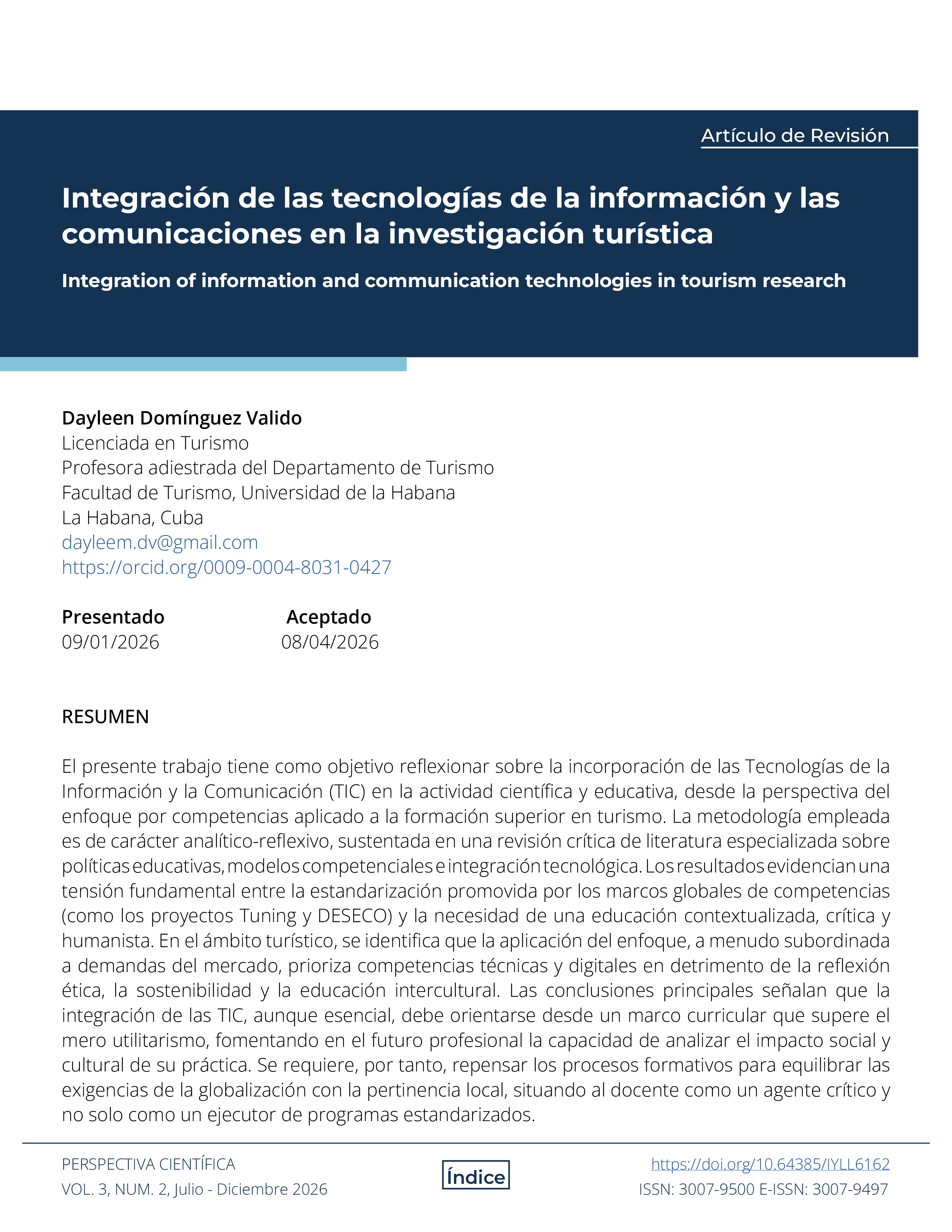
Integration of information and communication technologies in tourism research
DOI:
https://doi.org/10.64385/IYLL6162Keywords:
competency-based approach, ICT, higher education, tourism, globalizationAbstract
This work aims to reflect on the incorporation of Information and Communication Technologies (ICT) in scientific and educational activities from the perspective of the competency-based approach applied to higher education in tourism. The methodology used is analytical reflexive, based on a critical review of specialized literature on educational policies, competency models, and technological integration. The results reveal a fundamental tension between the standardization promoted by global competency frameworks (such as the Tuning and DESECO projects) and the need for a contextualized, critical, and humanistic education. In the tourism field, it is identified that the application of the approach, often subordinated to market demands, prioritizes technical and digital competencies to the detriment of ethical reflection, sustainability, and intercultural education. The main conclusions indicate that the integration of ICT, although essential, must be guided by a curricular framework that goes beyond mere utilitarianism, fostering in future professionals the ability to analyze the social and cultural impact of their practice. It is therefore necessary to rethink training processes to balance the demands of globalization with local relevance, positioning the teacher as a critical agent and not merely an executor of standardized programs.
Downloads
References
Díez, E. (2009). Globalización y educación crítica. Ediciones Desde Abajo.
Hernández Castellanos, D. A. (2022). Arqueología del saber y orden del discurso: Un comentario sobre las formaciones discursivas. Enclaves del Pensamiento, 4(7), 45– 62. https://scielo.org.mx/pdf/enclav/v4n7/v4n7a3.pdf
Lozano Camacho, F. E. (2024). Innovación educativa: Integrando las TIC en la educación superior. Ciencia Latina Revista Científica Multidisciplinar, 8(1). https://doi.org/10.37811/cl_rcm.v8i1.9935
Moreno, T. (2010). Competencias en educación, una mirada crítica. Revista Mexicana de Investigación Educativa, 15(44), 289–297.
https://www.scielo.org.mx/scielo.php?script=sci_arttext&pid=S1405-66662010000100017
Paz, M. J. (2023). ¿Cuál es el rol docente frente a la enseñanza dentro del paradigma competencial? Instituto de Formación Docente “María Orticochea”. https://repositorio.cfe.edu.uy/bitstream/handle/123456789/2474/paz%2C%20m.%2C%20cual.pdf?sequence=2
Prendes-Espinosa, M. P. (2023). Retos de la competencia digital del profesorado iberoamericano de educación superior. MetaRed.
https://www.metared.org/content/dam/metared/estudiosinformes/Informe%20IB%20Metared%202023.pdf
Saldaña-Duque, R, & Sánchez-Peña, A.L. (2024). Educación por competencias en la educación superior. Una mirada a las pedagogías y el desarrollo humano. Sophia, 20(2), e1233. https://doi.org/10.18634/sophiaj.20v.2i.1233
Rivas García, R. M., Cardoso Espinosa, E. O., & Roldan Castellanos, M. L. (2024). Planteamiento de las competencias profesionales en turismo desde la perspectiva de los egresados en México. RIDE. Revista Iberoamericana para la Investigación y el Desarrollo Educativo, 15(29), e735.
https://doi.org/10.23913/ride.v15i29.2094
Riveros, G. M. (2025). Tendencias y reformas curriculares en la educación superior latinoamericana: Aportes críticos y análisis de investigaciones recientes. Universidad Nacional de Asunción. https://doi.org/10.56712/latam.v6i1.3458
Testón Franco, N., Salinas López, M. T y Ahumada López, E. R. (2023). La educación 4.0 en la profesionalización del turismo: una revisión teórica en la enseñanza del sector. Revista Digital Universitaria, 24(5). http://doi.org/10.22201/cuaieed.16076079e.2023.24.5.13
UNESCO (2023). Reimagining our futures together: A new social contract for education. Comisión Internacional sobre los Futuros de la Educación. https://unesdoc.unesco.org/ark:/48223/pf0000379707
Downloads
Published
Issue
Section
Categories
License
Copyright (c) 2026 Dayleen Domínguez Valido (Autor/a)

This work is licensed under a Creative Commons Attribution-NonCommercial-ShareAlike 4.0 International License.